Showing posts with label Rahul Bhattacharya. Show all posts

Sunday, August 4, 2013

The Art of Not Making


As it may be relevant to this discussion, I am re-posting this review of the book The Art of Not Making, which first appeared in Art & Deal magazine.


In 1917 an unknown artist named "R. Mutt" exhibited a perfectly ordinary porcelain urinal at the exhibition of the Society of Independent Artists in New York City. The actual person who lay behind this act of aesthetic sabotage was of course Marcel Duchamp. Through his radically clever mind he managed to transform an object as vulgar as a urinal into not only a memorable sculpture, but probably the most analysed and written about object in contemporary art history. Duchamp had simply placed a store-bought urinal upon a pedestal and titled it Fountain. In doing so he demonstrated that art became art simply by the artist declaring it to be. Duchamp also argued that it was the placement of an object within a relevant context that caused it to be raised from mundane existence to that intellectual pinnacle reserved for art. For Duchamp, the primacy of art lay in the realm of ideas, and whether or not art was the result of laborious work or instantaneous inspiration was immaterial. The social, aesthetic, and cultural ramifications of Duchamp's "creation" of Fountain are still very much with us today. There are few things more sacrosanct in the world of contemporary art than the premise that idea is superior to craft.


Of course ideas (concepts) have always been at the heart of art. The written histories of both Western and Eastern art revolve around how particular works of art represent the spiritual, cultural, scientific, or social concerns of their times. Idea has been paramount, though it is interesting to note that much of the art we admire in history books was actually the manifestation of ideas formed not by the artist, but by the artist's patron(s). Thus, Michelangelo worked within the confines of The House of Medici and the Catholic Church of Rome, and the humanistic values that many find in his art cannot be divorced from the overriding need of the artist to illustrate his patrons' ideas. Michelangelo, after all, created such things as the Sistine Chapel on commission, and his concepts were in large part bound to accepted versions of Biblical themes that he was paid to illustrate. His famous sculpture of David was a received commission from the Florentine Guild of Wool which made a clear directive that the sculpture was to be of the Biblical David and represent Florentine freedom. Nearly all of Michelangelo's work was contracted and given initial conceptualization by his patrons. Similarly, in the East, the miniaturists of the Persian and Moghul courts were bound to various dictates of Islam, inherited cultural norms, and the whims, commissions and decrees of princes and caliphs.


It is sobering to remember that throughout much of the world's history the artist was not thought of as an independent thinker, much less a visionary. Artists were judged "good" or "bad" largely upon their use of finely-tooled craftsmanship to bring into being the concepts of their patrons. As such, even the most respected artists were seldom given a status above that of master craftsman. True, many such artist-craftsmen managed to brilliantly improvise within the parameters of their patronage. But it was not until much later, with the demise of feudalism, the evolution of freer markets, and a growing emphasis on individualism, that artists came to be seen as independent thinkers, visionaries, messengers of truth, and innovators that question established orders within a liberated social-aesthetic space.


It is good to remember these things when delving into the new Thames and Hudson book, The Art of Not Making: the New Artist/Artisan Relationship (written by Michael Petry and released just last January.) Though this book has seen little attention to date, it is perhaps the most potentially subversive book dealing with contemporary art this year. The Art of Not Making is in fact a sort of "coming out" by artists of all stripes. On one level the book works as a mass-confessional, boldly addressing an issue that the art world has muttered about for years but seldom addressed in public: the fact that scores upon scores of contemporary artists do not make their own work. Author Michel Petry, himself an artist, is to be given credit for pursuing a very touchy subject with sincerity, candour, and a great deal of fairness and grace. The artists featured in the book also deserve credit for their honest admissions and cooperative interviews.


Petry, of course, begins his discourse with the mandatory reference to Duchamp. It is then pointed out that artists throughout the ages have employed other artists as assistants. There is a particularly memorable anecdote of a patron rejecting a painting he had commissioned from the Venetian artist Bellini as it was thought to have been painted primarily, if not totally, by the artist's assistants. But The Art of Not Making quickly catapults into the present. Michael Petry does as most of us involved in today's art world do...rather all-too-quickly accepting what has become a somewhat unquestionable premise: that the artist is primarily a conceptualizer whose true work is first and foremost in his or her head. The actualization of conceptualized artworks thus becomes a rather mundane, even routine encounter with craft. Contemporary acceptance of this premise stems straight from the provocation of Duchamp's famous urinal and the eventual integration of Duchamp's philosophy into the mindset of the cultural elite.


The Art of Not Making is filled with quotes that perfectly illustrate the prevailing acceptance of Duchamp's declarations. The Canadian artist Micah Lexier, speaking about his wall installation of 20,000 custom minted coins for the Bank of Montreal, sums up his use of craftsmen by saying, "I always have gotten other people to make things. I have an active mind, but haven't always been so good at making things, so I'd get something made, or printed, by someone else. It was a response to the skills, or lack of skills that I have." Similarly, the Egyptian-born artist Ghada Amer states,"I get involved in the craft aspect of the work but, rather than getting bogged down in making things, I prefer to look for new ideas and resolve new problems. So although I'm not a conceptualist, I like to teach other people to do the work for me; even my paintings are done with assistants". It is interesting to note in this quote that Amer claims "I'm not a conceptualist" while at the same time confessing that she does not like "getting bogged down in making things". One is left wondering just what it is that she does.


To be fair, most all of the artists interviewed in The Art of Not Making seem diligent and committed to their work. Some express a deep love for working with the various artisans they employ. The African-American artist Fred Wilson, talking about collaborations with glass artisans from the Berengo Studio in Murano, Italy, states that, "When someone else makes your work, who they are goes into it as well. If they are connected to it, the fabricator can develop a wonderful relationship with the artist....Each person brings a different talent and aspect to it. It can take you in another direction." Another American artist, Fred Tomaselli, while talking about working with hired Chinese tapestry weavers, states: "I have never differentiated between the realms of art and craft. As an artist I am very hands on; everything done by me, by hand, with only one assistant, so jobbing out to another person whom I never met and working in another country gave me some pause. But it's interesting to have the forms articulated by such great craftspeople."


But there are also voices within the book that sound disconnected and even downright arrogant. One example is the Italian Maurizio Cattelan, who, while speaking about his conceptual installation of a replica of the iconic HOLLYWOOD sign on the hills above Palermo declares: "The idea that the artist manipulates materials is not something that I agree with. I don't design. I don't paint. I don't sculpt. I absolutely never touch my works." It bears repeating: "I absolutely never touch my works." One wonders why this is spoken with such a degree of pride. One can accept an artist's desire to exist within the realm of pure ideation...but why the seemingly disdainful allusion to the process of craft?


And then, in other artists, there are the unavoidable implications of exploitation. Jochem Hendricks, a German artist with a reputation for probing complex moral and ethical issues, is represented in the book by "6,128,374 Grains of Sand", an artwork which is just that: 6,128,374 grains of sand enclosed in a glass egg. Petry states: "The only way to verify the count is to crack the egg and destroy the work of art,"...certainly an interesting enough concept. But Petry goes on to explain that the artist "paid assistants (often illegal immigrants in Germany) to count the grains of sand". Moral questions indeed.


Subodh Gupta is, I think, the only Indian represented in the book. It is a pleasure to find him discussed as just one more among a host of international art stars (rather than being segregated and categorized as an "Indian Artist"). Gupta joins the conceptual choir in stating, "I transform. My job as an artist is to think, to conceive the ideas." And then rather surprisingly (at least to me) he adds: "My art is made up for me by expert artisans all over the world: the thali works were made in America." Of course my surprise stems from having thought his thali works were made by Indian artisans, not American.


Perhaps the most disturbing moments in the book are not the many quotes and interviews with the artists, but rather, the voices of the craftspeople. It is discomforting to read how seemingly content they have become in their roles as "makers" for the "conceptualizers". One such "maker", London-based Anthony Harris, when asked about the question of authorship replies, "When does an architect build the building? When does a composer play an orchestra? ....It doesn't matter who made it. Do you like it, will you buy it, how much do you want to pay for it? That's it. The creative process is complete: idea, object, sale!"


As a whole, The Art of Not Making becomes a fascinating book that conjures more questions than it answers. But we are left to return to the realization that once upon a time it was craft that was valued more than idea. Ideas were left primarily to the powerful patrons who commissioned the work. In that sense, have the new generation of "office artists" (as I like to call them) who "absolutely never touch" their work, become the new patrons of talented and unsung artist-craftsmen who have entered into a newly subservient social position? Have the office artists who spend their days conceptualizing, networking, and marketing, in fact become non-artist businesspeople who work as defacto agent-advisors to craftsmen? Is it the "craftspeople"... who have spent too much time learning the technique of their art to be able to effectively conceptualize and promote it...who are, in the old-fashioned sense of the term, artists? Who is advisor, who is agent, and who is artist? I do not ask these questions with any mean-spiritedness, as I myself have become, at least partially, an office artist who works with studio artists and craftsmen to fabricate my ideas. But to avoid these questions is perilous...not only for artists and craftsmen as individuals, but to the integrity of the art community as a whole.

Thursday, July 18, 2013

Excuse me,

Excuse me,
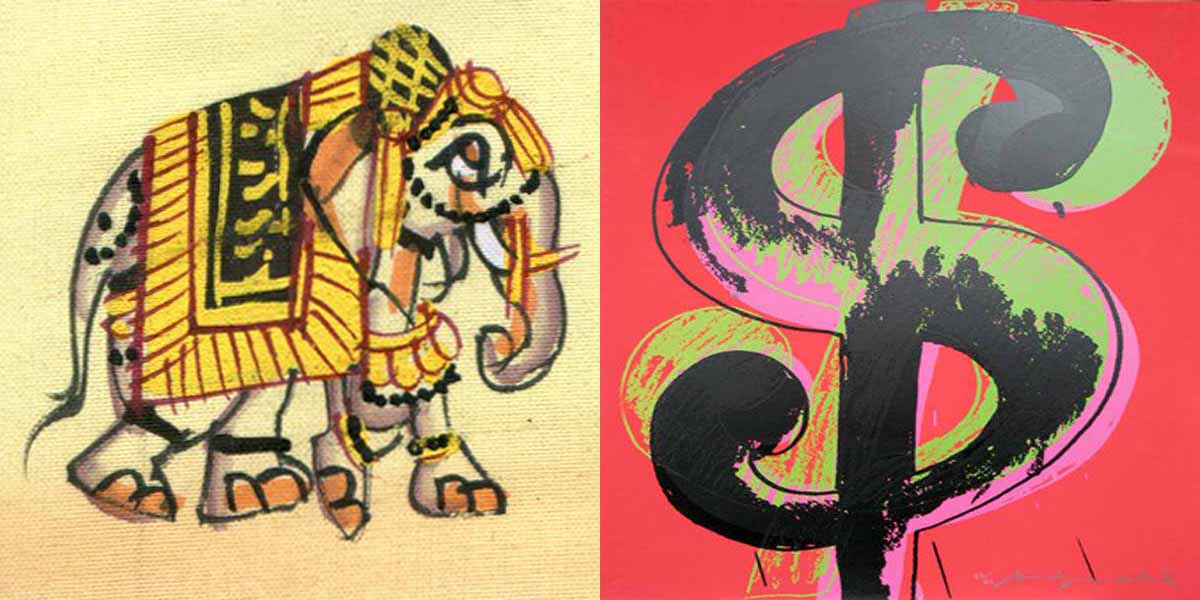
Is it hand-painted ? What is the edition number ?
 Is it hand-painted ? What is the edition number ?
Is it hand-painted ? What is the edition number ?

Pictured: Hand-painted 20/rs note cards from the Udaipur tourist bazaar featuring camel (love/sex), horse (power) and elephant (luck). Andy Warhol serigraphs and reproductions (signed and unsigned) found offered for sale via the Web.  

Wednesday, July 17, 2013

The Most Incredible Rise of Blitzvin of Batanrush


Story by Waswo X. Waswo with illustrations by Amit Biswas

Blitzvin had been interested in art since her childhood. When young, she had whiled away hours drawing her native town of Batanrush...its little houses with smokestacks and its aging, half-dead trees. She hadn't been the greatest of drawers, but she persisted. Blitzvin was not particularly good in school; in fact, Blitzvin was not particularly good at anything. She lagged in science and math, but her teachers encouraged her with art. It was, after all, one of the few things the poor girl was mildly proficient at.


It took all of Blitzvin's talents of persuasion to convince her aging mother (a widow on a pension) to send her away to Bolthank Semi-Accredited University (BSU) in the nearby town of Bolthank. Indeed, it took a bit of crying, a long talk to her mother by her 10th Standard teacher Miss Batsvin, and Blitzvin's solemn promise to do her best to make something out of her fascination with art. "Mother, if nothing else I will come home with a degree that is easy to get. Do you think I can do any better? Maybe a degree in art from BSU will allow me to one day become a window decorator at the Bolthank Mega-Mall. Think of how proud you will be!" Her mother had eventually relented and young Blitzvin eagerly packed her bags for the big town of Bolthank.


At Bolthank Semi-Accredited University the eager young Blitzvin discovered a new world. The Department of Applied and Imaginative Arts was amazingly free thinking. Waves of new ideas rushed into her like the crisp cool air of the Bolthank breeze. Blitzvin soon discovered a love for art history. She actually began to read one or two books (she had never before read books that had not been assigned), and one day she woke up for the very first time with a dream of becoming a real artist. Being an artist was no longer just an escape from the rigours of school trigonometry, physics, and calculus. Being an artist, the young girl suddenly realized, was a sort of divine calling. She, the humble young girl from Batanrush, knew she must heed that call.


Blitzvin applied all of her energy to learning the history of art. Unfortunately, her own skills did not match the craftsmanship evident in the works of the "old masters" that she was now coming to know through books. She worked harder and harder at perfecting her skills of observation, composition, and draughtsmanship, but it just didn't seem she had the innate ability. One day when Blitzvin was particularly depressed about this fact she noticed the ever-so-handsome Blivner Bochner, an Advanced Student, looking over her shoulder. Blitzvin was mortified that he was seeing her unfinished sketches! But Blivner just smiled and put his hand upon her shoulder. "Why do you work so hard at these sketches Blitzvin?" he had asked. "Do you really think you will learn to work like the old masters? Even our teachers cannot work like that. Don't you know what you are doing is completely unnecessary? It is your ideas that count! Concentrate on your ideas! That is all that is important!"


Just a year later, when Blitzvin entered the Advanced Class, she realized how true these words were. To her surprise the students in her class were quite dismissive of what she felt were her best drawings and paintings. "That work is purely illustrative!" one had declared. Another, a smart young girl from the cosmopolitan town of Noychnya, had added, "You are just a craftsman! This is not art! Art must have ideas!" Thankfully, the handsome Blivner Bochner, who was by now an unofficial assistant to Professor Blatskya, came to her rescue. He grabbed what Blitzvin thought was one of her worst drawings. It was a drawing that was coffee-stained, and crumpled and torn because she had almost thrown it away! But handsome Blivner held it aloft for the rest of the class to see. "Look at this work!" Blivner Bochner had declared. "It tells a story of anguish and heartbreak! Look how shaky and imprecise is the line! This work speaks of frailty and nervousness in the face of great tragedy. The tragedy of small-town Blotsvia!" Blitzvin had blushed with embarrassment, but she also realized her classmates were cooing with approval. "Yes," chimed in the cosmopolitan girl from Noychnya, "That is her best work. Perhaps this girl from Batanrush will yet become an artist!"


As the months proceeded in the Advanced Class at BSU young Blitzvin learned so very much. She learned that art was concept and not skill, idea and not work. Students who insisted on trying to paint like the old masters she once had so diligently studied were derided as derivative, nostalgic, and obsessed with "mere craft". For her Examination Exhibition Blitzvin carefully selected the simplest of her drawings, and the least worked of her paintings. She concocted elaborate stories about their meanings. She not only passed her final exam, she won a prize! She graduated with pride.


It was at this time that a letter arrived from Blivner Bochner. He had graduated the year before, and now worked as Assistant-to-the-Chief-Assistant at the Government Hall of Prestigious Exhibitions in Noychnya. To Blitzvin's delight the handsome young Blivner remembered her! In his letter he explained that he had a "certain relationship" with the Honourable Director of the GHPE, and that it was within his power to secure her an exhibition at this venerable Blotsvian institution! Poor Blitzvin shook with delight and fear! She wiped a tear from her eye. Such opportunities came to few!


But what to show?! She hadn't enough work, and still had lingering doubts over her own abilities. Then she remembered her photography! She had rolls and rolls of film, taken with an old Blotsvian MegaFlex camera! Blitzvin knew photography was becoming a rage in Blotsvian art circles. She dashed off with a handful of film to the local processing lab and handed over five rolls. "Blow them up as big as you can!" she had ordered. She was disappointed to learn that the biggest the local lab could print was 70 x 100 Blotsvian Inches. But it would have to do.


When the colour photographs were delivered to her door a few days later she eagerly went through them one by one. She carefully discarded those images that looked too pretty. She had learnt by now that an artist needed to always avoid the beautiful. "These twenty will be just right", she thought, "There is nothing illustrative or pretty about a one of them!" Blitzvin carefully packed the selected photographs and sent them off via courier to Noychnya. She spent the next few days writing a lengthy "artist statement" explaining the depth and layers of meaning in her selected work. Reading all of those art history books and contemporary art journals was proving helpful after all!


But something happened, as something always does, especially in a place like Blotsvia. Blitzvin had made the mistake of labelling her parcel HANDLE WITH EXTREME CARE and FRAGILE ART ENCLOSED. It was, of course, intercepted by the Provincial Inter-Provincial Customs Authority (PIPCA) at the border of the Province of Noychnya. It was late during the night shift when the officiating customs regulator opened the parcel. The word ART had caught his attention, and he dreamed of finding a magnificent oil painting with which he could adorn his home. "Lost in Transit" was always such a convenient explanation! In fact he had a rubber stamp that said just that! But to his dismay he had found Blitzvin's profoundly unbeautiful photographs.


That night the men at the PIPCA of Noychnya made the most rude and uneducated remarks about poor Blitzvin's art! They handled the photographs with complete disrespect, grimacing with disbelief at how dull and lifeless they were, and wrinkling their noses as they asked each other, "This is what someone calls ART"? As the night wore on the officers of PIPCA (and their subordinates and sub-subordinates) passed more and more good Blotsvian Blanko Blanko beer around, swilled good Blotsvian Fermented Bleacheno, and made more and more fun of Blitzvin's fuzzy photographs. The more they drank the more amusing they found her "art". They were by now carelessly throwing the pictures upon the floor, and peons came by who threw them into dustbins. It was not until late the next morning that the PIPCA officers sobered up and felt some remorse. A few of the more dutiful men thought to uncrumple the now totally destroyed photographs. "Let us pack them again and send them on their way," suggested one of the sub-subordinates. "No real harm done," offered another. When Blivner Bochner opened Blitzvin's parcel the following afternoon, in the prestigious secondary offices of the Government Hall of Prestigious Exhibitions (GHPE), he let out a little gasp and shuddered with disbelief.


The opening was of course a gala affair, as only Noychyna knows how to give gala affairs. Glasses tickled with the best Blotsvian Chenko Chenko that Blotsvian Bulliwarks can buy. Raw Blotsvian Botuui Fish was served on dainty skewers. Everyone waited for the entrance of the amazing young artist from Batanrush. Poor Blitzvin entered this scene with no knowledge of what had befallen her works in the office of the PIPCA of Noychnya! When she entered the grand exhibition hall of the GHPE she stood momentarily aghast. Her works were displayed in ruins! Yes, they had been properly mounted under glass, but it was obvious that they had been destroyed! The photographs were bent, torn, fingerprinted, coffee-stained, and dribbled with what looked like the gravy of Blotsvian Beanoguk! A scream of horror and outrage was about to escape her lips when Madame Vlitinknya, Noychyna's most esteemed art critic, swept up to her side and made a gracious bow. "Your works are superb! I have never seen an artist so question the sterile 'factuality' of photography! I know exactly what concerns you and you have addressed the problem with aplomb! You have mixed the mere image of mundane existence with the gritty reality of mundane existence! You have captured life as we suffer it in Blotsvia! My hearty congratulations my dear!"


As Blitzvin was recuperating from both her initial shock, and the effulgent praise from Noychnya's most respected critic, the handsome Blivner Blochner strode up smiling confidently. "I knew you had talent...but I never expected that first crumpled drawing I saw of yours was the beginning of your style! I am being credited with discovering you my dear! I have been promoted from Assistant-to-the-Chief-Assistant to Assistant-in-Chief," and then he muttered in confidence, "I think I am on my way to the top!"


It was only three months later that Blitzvin was being scheduled for a solo exhibition at the Galleries Blitin & Blotin in the capital city of Blotzinkin. Little was it known that one of the proprietors of Blitin & Blotin was in fact Madame Vlitinkya's half-sister Mildred. Madame Vlitinkya and Mildred Blotin worked in tandem, so exhibitions at the Galleries Blitin & Blotin were guaranteed good reviews. Before the proposed exhibition (Blitzvin: New Work) the two women had sequestered Blitzvin and given her council. "We want canvases! Your photographs went over just fine at the GHPE in Noychyna, but did you sell any? This is Blotzinkin, the very capital of Blotsvia! The collectors will demand canvases!"


"But I don't know how to paint! At least not well!" protested the stunned young Blitzvin. "People will see that I have no skill!"


"Nonsense!" Blotin and Vlitinkya had replied. "We will have someone paint them for you! Blotsvian craftsmen are very cheap! Just give us some more of those precious and inspired photographs, and we will have them painted on canvas for you! You are a genius my dear! Real artists are too busy conceptualizing to paint their own canvases! Everyone knows that! Well...not everyone." The two gave each other a wink and a laugh. They were obviously referring to Blitin, who was wealthy enough to be a partner in the gallery, but took little actual interest in its day-to-day routine (his main function was to buy a work from each and every show "Blitin & Blotin" mounted, thus securing the first "sale"). Bliztvin was confused, but did not want to disappoint. She knew she was on the way to becoming a real artist! Her mother would be proud! A day later she returned with the prints derived from five more rolls of MegaFlex film.


Three months later twenty large canvases were delivered to her doorstep (the gallery had provided her with a small studio space in a not-so-fashionable part of town). She unrolled the glossy new paintings, signed them, and then set about crumbling them, tearing them, pouring Blanko Blanko beers upon them, burning them with cigarettes, and, new in her repertoire, smearing tomato sauce in a few strategic areas. "There," she said to herself, "They are finished! And my work really is superb! It really is! After all, these were my ideas! My vision! And it is I who have made them come into physical form!" Unbeknownst to dear Blitzvin, the advocates at Galleries Blitin & Blotin were kept constantly busy threatening the "makers" (as they termed the mere craftsmen) to uphold the secrecy and non-disclosure clauses in their contracts.


It was not long after Blitzvin's sold-out Blitin & Blotin show that her career accelerated with breakneck speed. The location of the gallery in Blotsvia's capital city ensured a steady stream of foreign visitors. Assorted international collectors, official dignitaries, ambassadors and cultural attaches were frequent guests, as were curators from prestigious international museums. The rising young art star of Blotsvia, always snobbishly referred to as just "Bliztvin" (as if anyone ought to know that name) or "Blitzvin of Batanrush" (for those deemed less cognisant), was beginning to exhibit worldwide. And the graph of her auction sales was zooming off the charts. In fact, the pressures of the many scheduled shows were so great poor Blitzvin was finding it hard to keep up. It seemed that each and every gallery expected new work. It seemed that each and every gallery expected both something "new" but also something identifiable with her "brand" (she liked to think it a style!). In spite of the addition of umpteen new assistants, Blitzvin slaved for hours in her studio (which was actually much more like an office), making Skype calls to curators, writing ever more convoluted artist statements, drinking Chinko Chinko straight from the bottle as she smoked good Blotsvian cigarettes...and struggling to keep up with the hard work of "ideation" as she now haughtily referred to her primary talent.


Blitzvin was no longer the innocent young girl from Batanrush. She had become a sensation, and she relished it. The day she bumped into Blivner Bochner, at an opening in the Galleries Bliton & Blotin, she had actually cold-shouldered him. How could she give a mere "Assistant-in-Chief" at the GHPE (in lowly Noychnya!) a warm welcome, especially in front of the likes of the Director of the National Museum of Periphersthan! Why, it might give the impression that she actually associated with such common people! Yes, her work might speak of the mundane lives of common Blotsvians, but she of course had risen above that! In fact, she had just received an invitation for a solo exhibition at the Centre Pompusque in Partisthan! It was inconceivable that people think she was charmed by the likes of a poor, pathetic peon like Blivner!


But the Pompusque! What an honour and what a responsibility! What was she to show? This was the most momentous challenge the talented Blotsvian artist had ever faced. In the dark of the night she took her private car and her private driver and made the long journey back to BSU in Bolthank. There she arranged a clandestine meeting with Professor Blatskya. "I need your help!" She frankly declared. "You are so well versed in art history and contemporary art practices! But you stay isolated and don't actually know anyone in the "scene"! I want you to conceptualize my exhibition at the Pompusque! This is beyond my capacities for ideation! You will, of course, have to sign a contract of secrecy and non-disclosure." Professor Blatskya was at first taken aback. But he slowly grinned and spoke in a meaningful voice, "You have learned so well my dear. Who would have thought you were to become my best student? I have admired your progress in the world of art from afar. Your talents at painting are beyond my own! It would be an honour to assist you." Blitzvin breathed a silent sigh of relief. She had feared this encounter, but now she felt comfortable. She wondered if Professor Blatskya knew that she did not paint her own paintings. Did he truly admire her work? Later that night, as she turned for the door, the Professor had thrown out one last question, "How much will I be getting paid?" Blitzvin turned, unshaken, "You need to negotiate that with my handlers. Please call the gallery tomorrow, and make sure you speak only with Blotin."


Little did Blitzvin of Batanrush know that her much anticipated exhibition at the Pompusque had been approved only after great debate. The Grand Committee of Grand Committees (that decided such things) was not at all unanimous. There had been voices of objection. It was once shouted, "This is not the kind of show that brings in the revenues we require! And you know it!" At another time a voice was heard to exclaim, "Everyone is interested in Ponksvian art this year! What are we doing filling our schedule with this Blotsvian?" But wiser voices had prevailed. "The Centre Pompusque has never in its history presented a solo exhibition by a Blotsvian artist. What is more, Blitzvin of Batanrush is a woman! And you know how those damn feminists have been breathing down our necks!"


The evening of the vernissage for Blitzvin: An Ever-Emerging Retrospective in the hallowed halls of the Centre Pompusque, in the Partisthan capital of Posh, Blitzvin strolled confidently into the crowd of socialites wearing a perfectly stunning coffee-and-beer-stained creation by the Blotsvian designer Bruffecto. Yes, her style and her ideation were being copied, stolen, counterfeited and commercialized. Blitzvin t-shirts stacked the shelves of the Pompusque's gift shop. Blitzvin was being seriously discussed in the art history courses of Partisthan art academies. And she loved it! She swirled amid the cameras and the crushing journalists and strode boldly into the thick of the glitterati. A toast was proposed by the Director of the Pompusque: "To Blitzvin of Batanrush! Not only does she represent the best that Blotsvian Art has to offer! She represents the best of art today!"


Bliztvin stood with her glass held high in the air. Her head swirled. It seemed the entire room was beginning to circle around. She was vaguely aware of the fact that she had not yet seen her own paintings. She had not yet read her own artist statement! She wanted to! But there were too many admirers! She felt herself growing faint. She was longing for something...but she didn't know what. And then she realized just what it was! She was so thirsty for a good cold Blotsvian Blanko Blanko! And a heaping bowl of Blotsvian Beanoguk! But the room continued to swirl, and she knew she couldn't find those things in Partisthan.


copyright 2012 by Waswo X. Waswo